
Feeds
2011-08-29 14:36
This was the day I was dreading and, with one exception, it was as bad as I was expecting.
Here’s what I said the other day, in an article titled Dread:
This team is built the same as so many of those other A’s teams that failed in the playoffs: full of guys who mash a bunch of home runs off mediocre pitchers in the regular season, but who also simply don’t have another gear, where they can take good pitches from the kind of good pitchers you face in the playoffs, and do something with good pitches.
That’s exactly what happened in Game 1. White Sox starter Lucas Giolito was pitched well, locating his fastball on the corners, and then throwing enough off speed pitches to keep the hitters off balance. Giolito gave them no mistake pitches, so the A’s did absolutely nothing. He threw a perfect game for six innings, until Tommy La Stella punched a grounder up the middle for a single.
Giolito then started to tire in the eighth, the A’s got some runners on and managed to get one run home, and actually got the tying run to the plate. But once again, as the playoffs contrast the regular season, the A’s didn’t get to face a mediocre relief pitcher who would feed them a mistake pitch to feast off of. They were up against Aaron Bummer, who has a 0.96 ERA. He got La Stella to ground out. The rally ended, and the A’s had no other chances to score.
In contrast to Giolito’s mistakelessness, A’s starter Jesús Luzardo made two: a couple of fastballs that didn’t hit the corners but instead leaked out over the plate. In an ordinary regular season game against an ordinary team, the other team probably fails to take advantage of the opportunity presented to them. But the White Sox are a good team, not a bad one, and Adam Engel and José Abreu crushed those two pitches for home runs that gave the White Sox a 3-run lead that they never relinquished.
In addition to those mistakes, they also had one particular player, Tim Anderson, who had the skill set that every A’s playoff team in the Billy Beane era seems to lack: the ability to do damage with good pitches. Anderson went 3-for-4 in this game, and I don’t think any of the pitches Anderson got hits on were bad pitches. He just had the skill to do something with the pitches he was given, even if they weren’t mistakes. That put offensive pressure on Luzardo, and in particular led to the mistake pitch to Abreu.
The White Sox are quite simply a team that is better built for a three-game playoff series than the A’s are. Their weakness is that they only have two really good starting pitchers, so if the A’s can somehow manage to win Game 2, they do have a chance in Game 3, because they won’t be facing the kind of mistake-free pitching that gives them such trouble. But they have to get there first. Otherwise, tomorrow’s A’s game recap will be the last one.
The first day of the playoffs coincided with the first presidential debate. I didn’t watch it. I went for a bike ride instead, to avoid spending a painfully awful hour and a half of television. I knew it would be bad because Trump is trailing in the polls, and he really needed to make Biden look bad, to goad him into making mistakes and looking tired and flustered and confused and unpresidential, to turn the election into a lesser-of-two-evils choice, and so Trump was going to be at his absolute worst. Trump’s only play was to try to win ugly, and so it was going to be ugly.
And when I got home from my bike ride, I was greeted to exactly that news, that the debate was the worst debate in the history of civilization. But the good news is that Biden did not seem to take the bait. He didn’t hit any zingers that landed any sort of knockout blow to Trump, but he also didn’t give Trump the one thing he was fighting so desperately to get: a good pitch to hit. There was apparently nothing that Biden did or said that Trump could use to knock him out of the park with.
When you’re in the lead, don’t give the other team any freebies. Make them earn every single point. And when your opponent is a one-trick pony who doesn’t know how to do anything but pounce on the mistakes of others, all you have to do is not make any big mistakes and you should be able to hang on for victory.
We had one day yesterday with nice enough air to go outside for awhile, and one day yesterday with normal enough news to be able to focus our thoughts on baseball alone for a change.
But that didn’t last long, for this afternoon news came out of Louisville that nobody would be indicted for killing Breonna Taylor, only for “wanton endangerment” by shooting into the walls of the neighbors.
I don’t know that I expected anything else. It is nearly impossible to prove murder beyond a reasonable doubt with police officers, particularly when there’s no video of the incident. So there are rarely any consequences for these acts of, at worst, malice, and at a minimum, pure incompetence. So the show keeps going on. It’s infuriating.
In my opinion, there needs to be something between a murder charge and innocence, something more easily provable like “deadly incompetence” or something, where if police officers screw up and people die or get seriously hurt, they at least lose their jobs and never get it back. Otherwise, trust in the police will keep eroding to the point it becomes impossible for them to be effective.
And what does it even mean for police to be “effective” anyway? What is their mission? That’s where I think my political philosophy as I wrote in The Quick Start Guide to Human Society™, of “give people freedom in an environment of trust” can come in handy. If you view the job of the police to preserve order, then you give them a lot of power to rein in “bad guys” enforce the status quo, at the risk of allowing that power to be abused. If you view the police as an instrument of unjust hierarchies, then you want to remove their power to remove the status quo, at the risk of the chaos of lawlessness.
But if you look at the mission of the police as being there to create, defend and preserve trust, so that freedom can work its magic, then you can measure their effectiveness on a different scale. You wouldn’t measure them on crime rates, or on their abuses. You’d measure and incentivize the police on how much the society they serve trusts them and their fellow citizens in that society. If they fail to stop and prevent crime, they’ll also lose trust among the citizens they serve. But if in doing so, the police unjustly target and persecute a group of people, they will lose trust among that group of people. Right now, many police departments across the country don’t seem to care that they aren’t trusted by minority groups. They don’t care about trust because they don’t view trust as their mission, they see catching bad guys as their mission.
That’s another example of the Data/Human Goal Gap I once wrote about. If you measure yourself on catching bad guys, but your real goal is to create trust, you will start out increasing trust as you catch more bad guys, but eventually the trajectory your mismatched measurement takes you on will make you shoot past your optimal point, and you’ll suddenly find yourself decreasing trust even as you improve your crime measurements.
Anyway, that’s my two cents, which I kept to myself all afternoon as these events were unfolding. There are far more important voices than mine on these matters who deserve the airspace. People who are more directly affected than I am. People who are angry, upset, outraged, and rightly so. But this is a diary of sorts of these strange times, so I don’t want to leave it unaddressed, either. It’s what’s been going on in my head as these events unfold.
As I watched the A’s-Dodgers game last night, which the A’s won 6-4 thanks to some late inning heroics by Ramón Laureano, and these thoughts floated through my mind, I had one eye on my Twitter feed trying to figure out what was going on with the Breonna Taylor protests in Downtown Oakland. My two oldest kids happened to be visiting someone in Oakland, and I was supposed to be picking them up at some point that evening. But that can be difficult if the protests are happening near the police station, which just happens to be quite near where the tunnel between Alameda and Oakland empties out. I didn’t want to get stuck in that tunnel if protesters decided to shut down all the streets in that area. I didn’t want to be in the middle of all that if people were really angry.
In the end, it turned out that the protest kind of fizzled after 10pm, and someone else was able to give my kids a ride home, and nobody ran into any inconvenient traffic holdups.
But whether or not we actually got stuck in traffic is not the point. One of the purposes of those protests is to inconvenience people like me, a person can usually ordinarily go about his life without even thinking that an ordinary act of being in one place or going to another place contains any sort of risk at all, while more oppressed people, on a daily basis, have to consider the risks of even the most ordinary acts of human behavior. For me, I had to think about those risks on one particular evening. For others, those risks have to be considered all the time. Even when you’re lying in bed in your own home, like Breonna Taylor was.
Nobody should have to think that way. Everyone deserves an environment of trust, where they can live without calculating that even the simplest of decisions may be too risky, where they can do what they truly want to do with their freedom, even if it’s something as simple as sitting in their homes and watching baseball, and to do so without worry and fear, in peace.
In most team sports, the truly elite, best-of-all-time teams win about 90% of their games. The best regular season NFL team of all time won 100% of its games. The best regular season NHL team of all time (counting ties as half a win) won 91% of its games. The best regular season NBA team of all time won 89% of its games. The best English Premier League of all time won 88% of its games.
Baseball is harder. The best regular season MLB team of all time, the 2001 Seattle Mariners, won just under 72% of its games.
Even if you’re the best team in baseball, on some days, the best player in baseball will beat you. Or a starting pitcher who is better than your starting pitcher that day will beat you. And it’s not some occasional random fluke. It will happen about 35-40% of the time. That’s baseball.
I think we sports fans who enjoy multiple sports sometimes forget how different baseball is. If we think our team is good, we carry our other-sport expectations with us, and want them to win about 90% of their games. When they don’t, we feel like they’re not living up to their potential. We feel like they’re letting us down.
The lesson, therefore, is: never watch any other sports. Watch baseball, and only baseball.
That’s a joke, of course. Baseball is my favorite sport to watch, but I never really played it much. As a player, my sports have been basketball (before my back and knees made me quit) and soccer. But with contact sports being out of the question because of the pandemic, I’ve had to resort to my (roughly) 23rd-favorite sporting activity, cycling, to get my exercise.
I get bored of most forms of exercise if I’m not chasing a ball. To give my cycling a goal to chase, I try to ride around and find something new. There’s a lot of construction going on near my house, so if I vary my routes, I can usually find something new that’s happened around town.
Yesterday on my bike ride, I was riding along the bayshore, and I came across three pelicans flying around in circles, looking for food in the bay, and as soon as they found something, quickly diving down to catch it. I filmed a video of one of them.
It was a very peaceful moment. For a few minutes, all the troubles of the human world disappeared. Instead, I was onstage for a performance by a completely different species. There was no anger, no disappointment, no frustration. There was just being, free of judgment.
When I got home from my bike ride, I opened up my Twitter and was instantly given two major pieces of information:
And then my Twitter feed was full of all sorts of opinions and judgments about these two major pieces of information.
These two news stories are completely independent of each other, but now they will always be linked in my mind, both because they arrived in my consciousness simultaneously, and because they were national stories, and even international stories, that both involved Oakland.
Kamala Harris, who was born in Oakland in the same hospital as my wife and two of my kids, could spend the next eight years as Vice President, and the following eight years as President, and every time sixteen years from now I think back about her career, and make some kind of judgment in my mind whether she was a good or bad VP or POTUS, I’m going to think about Ramón Laureano and the time he charged the entire Houston Astros dugout in the Oakland Coliseum in the middle of a pandemic.
That’s just how it is now.
Later that evening, the A’s lost their second straight game, 6-0 to the Angels. Mike Fiers didn’t really have his curveball, which made him much less effective than otherwise. Meanwhile, Dylan Bundy had all his pitches working for the second time against the A’s this season. And with two straight poorly pitched games, panic started setting into my mind. Oh NOeS! WE cAn’T WiN 90% oF OUr gAMeS iF wE LoSe tWo gAmES iN A rOW! WE NeEd NeW PItcHErS! MaKE sOMe tRaDEs!
That isn’t a particularly helpful or useful state of mind for a baseball fan. A baseball fan needs to be more like a pelican, circling around, calmly looking down at these events from a distance, only making a judgment when it’s worth taking a closer look at a particularly delicious-looking fish.
One of my most widely read essays was written in 2012, called MLB’s Customer Alignment Problem. In that article, I explained how increasingly, MLB’s revenues and franchise values were strongly tied to cable and satellite network fees. That was a problem because:
It seemed like a Ponzi scheme to me, or a house of cards, or a Jenga tower, pick your favorite metaphor. Every cord cutter takes a block out of that Jenga tower with them when they go. You never know when the tower is going to fall over, you just know that eventually it will.
That was eight years ago. Cord cutting has continued apace. It’s not so much that old fans cut the cord. It’s that they die, and aren’t replaced by young fans. Young people simply don’t buy cable TV. The average age of a baseball fan in 2007 was 53. In 2017, it was 57.
So now you’re starting to see articles asking things like Are Millenials Killing Baseball? The answer, of course, is NO, THEY’RE NOT. MLB simply isn’t reaching them, because MLB’s incentive structure stops them from meeting Millenials where they are.
Of course, last we checked, baseball isn’t dead. Last year, MLB’s revenues were fine, ratings were fine, attendance was fine, everyone was making money. And over the last eight years, most of those regional TV networks who had such a wobbly mutual dependence with MLB have gotten themselves folded into much larger corporate conglomerates.
But what happens if we pull some really big blocks out of that Jenga stack?
In the time of the pandemic, the trend has become clear — cord-cutting is happening faster. While widespread stay-at-home orders have catapulted the growth of streaming, the coronavirus pandemic has accelerated a parallel trend: a sharp decline in subscriptions to the cable bundle. Pay-TV providers are coming off their worst quarter ever, shedding more than 2 million subscribers in the first three months of 2020, or around 3% of the customer base. That’s equal to roughly 40% of the total losses pay-TV providers suffered all of last year.
Ouch.
None of us know the inner financial workings of any MLB teams. Nor do we know any of the inner workings of any of the Pay-TV providers. It’s easy to sit on the sidelines and say as many people do on Twitter, “You’re billionaires, suck it up.” But I think that attitude is based on an outdated idea of some sole Scrooge McDuck owner who sits on a pile of gold coins in his vault somewhere, where the price of a ballteam is a pittance for them. But nowadays, most MLB teams are so expensive that there are very few Scrooge McDucks who can own a team by themselves and pay for it with cash. Most teams are owned by an assembled group of people who pay for it using loans secured with collateral. These ownership groups really don’t want their collateral touched. That’s especially true if it’s some large publicly owned conglomerate on the stock market. Covering losses is not anywhere near as simple as asking McDuck to pull another coin out of his vault. Instead, getting any sort of decision made is a big giant mess of regulations and internal politics.
All of which is to say, this pandemic is creating a lot of pressure on MLB teams from a lot of different directions. And the first sign of that pressure is when the weakest link in the MLB value chain starts to break. And that weakest link is…drumroll please…the minor leagues.
Minor league teams and minor league players have a strongly dependent relationship with MLB, with absolutely no leverage at all. They are a source of cost for MLB, with very little direct revenue coming back to MLB. So when MLB revenues start to get squeezed, where do you think they’re going to look first to cut costs? The place with the least resistance to those cost cuts and the least effect on revenues, of course.
So now all of a sudden, the minor leagues are going to be reduced from 160 teams to 120. The draft is going to be reduced from 40 rounds to 5. What could the minor leagues and the new potential minor leaguers do about it? Nothing. They’re the weakest links in the chain. It was inevitable that they would be the first to crack.
You wonder, then, if this pandemic drags on for another year or two, what are the next-weakest links in the chain? Who will be the next group of people that MLB’s structural issues will collapse on top of?
* * *
Nobody could foresee this particular pandemic coming at this particular time. But the fact that some negative externality could lead to financial problems within MLB: that was entirely foreseeable. It’s been built into MLB’s business model for over a decade now.
One thing this pandemic has made clear: we are terrible as a society, and perhaps as a species, at dealing with slow-motion disasters. There are so many problems we can see coming from a long ways away, but we don’t do much about them because they’re a long ways away.
Until they’re not, and then it’s too late.
There are many slow-motion disasters that we aren’t doing anything about. Pandemic preparedness, in hindsight, was an obvious one. Climate change is another, of course.
Interestingly, the Republican Party has the *exact* same slow-motion disaster happening to them as MLB. Their whole business model, like MLB’s, depends on cable TV networks keeping old white people attached to what they’re selling. Their problem, like MLB’s, is that their demographic keeps getting older and dying off, and the young people don’t have Cable TV, don’t watch their schtick, and so they don’t buy into what they’re selling fast enough to replace the old ones who die off. It’s a slow demographic train wreck happening for them, and you can see it coming. The Republicans *know* it’s coming, that’s why they keep trying to hold that demographic train wreck at bay on the backs of America’s politically weakest links by restricting minority voting access and cutting immigration. That may work for awhile, but at some point in the next decade or so, demographic shifts will cause some big states like Georgia and/or Texas and/or Florida to flip, and then it’s game over. Their only advantage over MLB is that they only have one incompetent competitor to worry about, while MLB not only has to fend off their rival sports to stay afloat, it also has to fight new innovators like Netflix and video games and social media for attention.
The pandemic has added urgency to Republican dilemma, too, because if the economy doesn’t recover by November, that demographic train wreck might happen this year instead of 10-20 years down the line. So you’re seeing Republicans putting a lot of pressure on decision makers to “open up the economy” as soon as possible. But that, in itself, is another slow-motion disaster about to happen. The shelter-in-place orders have lowered the R0 of the disease from 2.5 to about 1.0 or even below 1.0, but as soon as it opens up again, the R0 will jump back up again. It probably won’t jump all the way back up to 2.5, because many people will be cautious and avoid high-risk activities, but it will probably jump back up to something like 1.5. And that means the death rate will look like it’s holding steady for a month or three, but then the exponential growth will start to take effect, and we’ll get a surge of illness and deaths in August or September or October that will be as bad or worse than the first one. But this time, the fall guys won’t be the politically weakest links as much as the physically weakest ones, who just happen to be the kind of old, sedentary people who spend a lot of time watching baseball and Fox News.
And then what?
When you start looking at a problem and it seems really simple, you don’t really understand the complexity of the problem. Then you get into the problem, and you see that it’s really complicated, and you come up with all these convoluted solutions. That’s sort of the middle, and that’s where most people stop. . . . But the really great person will keep on going and find the key, the underlying principle of the problem – and come up with an elegant, really beautiful solution that works.
Beginning a story with a quote often implies that the rest of the story will say same thing as the quote, but with different words. This story follows that formula. The opening quote serves as a box within which the rest of the story is confined.
This story is not original. It says what Steve Jobs said in the above quote. It says other things that other people have also been saying for hundreds and even thousands of years. So why bother telling this story?
We tell stories because there are simple approaches that don’t address the complexity of the problem. We tell stories because there are convoluted solutions where people have stopped. We tell stories because sometimes the underlying principle remains, but the old, elegant, once-beautiful solution has now stopped working.
Sometimes the lock changes, and we need a new key. Sometimes we refuse a key from one person that we will accept one from another. Sometimes this particular key won’t work for us, but a different key will click the door open. And sometimes we need to try a different door entirely to get into that room.
We tell stories because we are human beings, endowed by our creator with the delusion of hope. We tell stories in faith, believing, without evidence, that communication will forge a key that unlocks something incredible and amazing.
I got mad at my kids recently for having a messy room.
It’s such a cliché, I know. In that moment, I was an ordinary parent, just like everyone else, easily replaced by a thousand identical others.
Although, that’s not exactly true. I had my own, different angle on the messy room story. I didn’t really get mad because their rooms were messy. I got mad because their messiness was starting to spread out into my spaces, the common areas of the house that I keep clean. I did not want my space to be a new frontier for their stuff to conquer.
Wait, that’s not exactly the whole story, either. I didn’t even get mad because their stuff was getting all over the house. I got mad because when I suggested that we go to IKEA, like a good Swedish-American family, and look for some solution for where they can put their backpacks and schoolbooks and binders and such, so that I can keep my spaces clear of their stuff, they laughed.
I got mad because they laughed.
Is a story a kind of technology?
The word technology derives from the Greek words for “skill/craft” and “word”. Since a technology is a set of words about skills, perhaps a story is the original technology, the underlying technology upon which all other technologies are based.
We craft our words into a story, to transfer information from one person’s brain to another person’s brain. The more skillfully we craft our words, the more effectively that information is transferred, retained, and spread.
The most celebrated technologies of our times, Google and Facebook and Twitter, are merely extensions of this original technology. They are the result of stories built on stories built on stories over thousands of years, told orally, then in print, then digitally, all circling back to their original purpose. They are ever more effective tools to transfer, retain and spread information from one human being to another.
Once upon a time, about a billion years ago, life was simple. Everybody lived in the oceans, and everybody had only one cell each. This was quite a fair and egalitarian way to live. Nobody really had significantly more resources than anyone else. Every individual just floated around, and took whatever it needed and could find, and just let the rest be.
This golden equilibrium was how life did business for a couple billion years. There was no such thing as jealousy or envy, and as a result, everyone lived pretty happy lives.
Then, one day about 800 million years ago, a pair of single-celled organisms merged to become the first multi-cellular organism in the history of the earth.
At first, these multi-celled creatures were just kind of like big blobs of single-celled organisms, and didn’t cause a lot of problems. Everybody was still kind of doing the same job as everyone else, even if they had organized themselves into a limited corporation of sorts. Most other single-celled creatures just figured they were harmless weirdos hanging out together, and ignored them.
They could not have been more wrong. For once the multi-cell genie was out of the bottle, Pandora’s box could not be closed, and the dominos began to fall. This simple change may have seemed innocent at first, but little did the single-cells know that they were the first creatures on earth to fall victim to the innovator’s dilemma. The single-celled creatures were far too invested in the status quo to change, and consequently ignored the multi-cellulars as irrelevant, and did not realize until it was too late that the game had suddenly shifted.
Today’s trip down Random Wikipedia lane introduces us to book peddlers, who were ‘travelling vendors (“peddlers”) of books.’ I’m not sure why book peddlers warrant a wikipedia entry, when other door-to-door salespeople like broom peddlers or brush peddlers don’t.
I’ve never peddled books much, but I’ve peddled blogs plenty of times. I’m a lousy peddler, though. I admire a good peddler, but it’s not for me. There is a good reason why in my career I have ended up in engineering departments instead of sales departments. I just want to focus on making good products and leave the sales work to teammates who are much better at it.
I am beginning a Twitter exile, partly to devote some of the time that Twitter sucked away to my family, but also to take some of that time to get back to doing some blogging. I don’t seem to be able to both blog and tweet at the same time. For me, it’s either one or the other.
So in exiling myself from Twitter to return to blogging, the arises whether to peddle my blog entries over on Twitter, despite my absence there otherwise. The question boils down to this: why do I write at all? Is it for the social rewards of praise from others? Or is it for the reward of a job well done?
Twitter in its purest form provides the former, blogging in its purest form provides the latter. While I have, on occasion, created a well-crafted tweet, it is more a source of quick, easy, (though ephemeral) social rewards than a place where to get the satisfaction of a job well done. And while I have, on occasion, written a blog entry that provided the social rewards of being widely praised, most of the time, even the blog entries I gained deep satisfaction from writing have largely gone unnoticed and/or unfeedbacked.
And so an experiment: I’m going to quit peddling what I write, and I’m going to remove all analytics from my web site, and all comments, so unless someone takes the trouble to email me, I will have no idea whether anyone reads my stuff or not. Any peddling will come purely from the kindness of strangers, not from me. Is writing well its own reward? I guess I’ll soon find out.
I’ve been watching James Burke‘s series Connections (1978) and The Day The Universe Changed (1985) on YouTube lately. There was one passage that struck me in particular:
“Before 1450, life was intensely local. Most people lived and died in the same cottage, and never went further afield than seven miles. […] Here, in church, was where they got their word-of-mouth news about the mysterious and unreal world, out beyond the forest where nobody ever went. The pulpit was their TV, newspaper, wire service, calendar, landlord, lawyer, teacher, timekeeper, social diary.”
–James Burke, The Day The Universe Changed, Episode 4, “Matter of Fact”
Replace the word “pulpit” above with the word “iPhone”, and think about that for a second. What an amazing technology churches were! The church, once upon a time, was the state-of-the-art communications technology. For people in the Middle Ages, it performed many of the same functions that mobile phones perform for us in 2013.
Around 1439, Johannes Gutenberg invented the printing press, and everything changed. This technology, the church, which contained many different products in one, began having its functions stripped away from it one by one. Now that people wanted to read things themselves, you didn’t have just a single, monolithic technology called “church” anymore. You had churches, and schools. And books, and newspapers, and calendars. And as knowledge quickly started to spread because of the new printing technology, other innovations happened which plucked off more and more functions of the church.
550 years later, in 1989, Tim Berners-Lee invented the world-wide web. The iPhone followed 18 years afterwards, and gravity suddenly reversed itself. All these technologies, which had been blown apart half a millenium earlier, suddenly started consolidating again, back towards a single monolithic technology: the mobile phone.
* * *
Western religions have a linear view of time. They see history as having direction, a beginning and an end. They build empires, like Alexander the Great or Julius Caesar, and never expect these empires to fall. Another great conquest is always coming next.
Eastern religions like Hinduism see history as cyclical. The universe and everything in it comes into being, then cycles out of being, then back into being again. Or as Tim Lott writes about Alan Watts and Zen Buddhism:
The emphasis on the present moment is perhaps Zen’s most distinctive characteristic. In our Western relationship with time, in which we compulsively pick over the past in order to learn lessons from it and then project into a hypothetical future in which those lessons can be applied, the present moment has been compressed to a tiny sliver on the clock face between a vast past and an infinite future. Zen, more than anything else, is about reclaiming and expanding the present moment. […]
For all Zen writers life is, as it was for Shakespeare, akin to a dream — transitory and insubstantial. There is no ‘rock of ages cleft for thee’. There is no security. Looking for security, Watts said, is like jumping off a cliff while holding on to a rock for safety — an absurd illusion. Everything passes and you must die. Don’t waste your time thinking otherwise.
With a linear view of history, church administrators in the west spent a lot of the five and a half centuries following the printing press looking for that old security, never quite believing that their breakup was acceptable, yearning for the good old days when the church was all the technology anyone needed. History is moving in the wrong direction! People aren’t coming to church as much because of these newfangled books! Let’s invest in Baroque art! That’ll wow ’em back into the pews! We have to fix this!
* * *
The popular technology of the day seems to agree more with the Buddhist view that all that matters is the present. As Erick Schonfeld wrote in TechCrunch in 2009:
Once again, the Internet is shifting before our eyes. Information is increasingly being distributed and presented in real-time streams instead of dedicated Web pages. The shift is palpable, even if it is only in its early stages. Web companies large and small are embracing this stream. It is not just Twitter. It is Facebook and Friendfeed and AOL and Digg and Tweetdeck and Seesmic Desktop and Techmeme and Tweetmeme and Ustream and Qik and Kyte and blogs and Google Reader. The stream is winding its way throughout the Web and organizing it by nowness.
Alexis Madrigal thinks, however, that a backlash towards this nowness has begun in 2013.
Nowadays, I think all kinds of people see and feel the tradeoffs of the stream, when they pull their thumbs down at the top of their screens to receive a new updates from their social apps.
[…] And now, who can keep up? There is a melancholy to the infinite scroll.
Wouldn’t it be better if we just said … Let’s do something else? Let’s have the web be a museum or a curio box or an important information filter or an organizing platform.
* * *
Time Magazine named Pope Francis its Person of the year. I’m Lutheran, not Catholic, but I admit I am fascinated by the man. Robert Barron at Real Clear Religion, however, quibbled with Time’s emphasis on the changes he’s making, and wrote this in response:
If I might cite the much-maligned Benedict, the Church does essentially three things: it cares for the poor; it worships God; and it evangelizes. Isolate any of the three from the other two, and distortions set in.
Those three things, here in 2013, are a lot fewer than the long list of things the Church did in 1413. I wonder then, if Pope Francis’ popularity isn’t just about the Pope’s message itself, but also about two linear arrows of history intersecting: a time the Church is ready for a pope to focus the Church on those three things, and also a culture at large that has reached a point where it is ready to hear a message about lasting values.
Perhaps now, in this peak-iPhone/webstream era, people have found out through their own experience that the Buddhists and the Christians each own a piece of the truth: that most things in life are transitory; yet there are a few select eternal truths worth hanging on to. Perhaps mankind is relearning an old lesson: that one should render unto Steve Jobs the things that are Steve Jobs’, and unto God the things that are God’s.
There is nothing so utterly ordinary in the fossil record of the planet Earth as the shell of a sea snail. They first appeared at the end of the Cambrian era almost 500 million years ago — nearly twice as long ago as the first dinosaur. In terms of number of different species, the Gastropod class to which sea snails belong are the second-most diverse class of animals on the planet behind insects. Unlike insects however, most sea snails make hard, mineralized shells which survive rather well in the fossil record. Therefore, they have left a long, long trail of their long, long existence everywhere around the globe.
Today’s Random Wikipedia Wheel of Fortune sends to examine one of these sea snails, the Trochaclis attenuata. The Trochaclis attenuata lives off the coast of New Zealand.
Here’s a picture of the shell of the Trochaclis attenuata. It looks rather big in this image, but note the scale on the bottom left; if the scale is to be believed, the Trochaclis attenuata isn’t much larger than an ordinary grain of sand.

The species was identified by a New Zealand researcher named Bruce Marshall, who registered the name of this species in 1995.
* * *
Ok, but so what? What is the point of thinking about the Trochaclis Attenuata?
* * *
Try to estimate how many sea snails there are in all the world’s oceans right this very minute. Consider that some of these sea snails are the size of a grain of sand. What’s your guess? 1 million? 10 million? 100 million? 1 billion? 10 billion? 100 billion?
Now imagine that number, whatever it is, multiplied over 500 million years. That’s how many sea snails have lived in the history of the earth.
* * *
Now imagine the latest human scandal that’s buzzing around your news feed right now. Whatever has you all upset and angry, hold that outrage in your mind for just a second.
Now place that outrage right next to your count of sea snails in the history of the earth.
Think about how, of all the sea snails in all the seas in all the history of the world, not one, not a single one, cares about your scandal.
Trilobites dominated the planet for 200 million years or so, then they went extinct. Sea snails lived on.
Then dinosaurs dominated the planet for another 200 million years or so, then they went extinct. Sea snails lived on.
67 million years later, you and your fellow awesome humans and whatever you’re outraged about arrived on the scene. 133 million years from now, who knows what will become of your fellow humans, but your outrage will certainly be extinct.
And the sea snails, the boring, ordinary little sea snails, will live on.
The A’s making the postseason has hurt the discipline I’m trying to develop as a writer. The little brain tingle I get from reading articles about the A’s or talking about the A’s on Twitter right now is so, so tempting and hard to avoid. I’ve tried to turn my feeds off during my daily writing window, but this week, I’ve been cheating. My writing habits after one month aren’t so strongly ingrained and automatic yet that they could override the temptation of A’s talk. My articles have been much shorter this week as a result.
Translating verbal ideas into unconscious habits is difficult. So much of our routine behavior functions subconsciously and automatically, so it’s a bit of a black box. We can’t see into our brains and see what is wired to what. So we often have to try various tricks to get our subconscious brains to do what our conscious brains want them to do. A recent Fangraphs interview of LaTroy Hawkins by David Laurila had a good example of this:
I chewed on that awhile and slowly tried to transfer the concept of how I felt on the basketball court when I was shooting my jump shot. I worked that into my delivery — my arm angle and my release point. I think that was the key for me, having him translate it into basketball terms. The ball coming off your fingertips when you’re shooting a jump shot isn’t all that different from delivering a pitch.
Hawkins’ brain was already wired to do something close to the right thing when he played basketball. Thinking about his pitching in terms of shooting a basketball created a pathway in his muscle memory to the right behavior.
That struck me, because I’ve used basketball as a kind of muscle metaphor myself in order to change a physical behavior. I have a bad habit of locking my knees when I stand, which transfers weight away from my legs to my back. It causes me back pain if I end up standing for too long. Somewhere in my life, my muscle memory became wired to stand this way, and it’s very hard for me to avoid this habit this without conscious thought. In trying to fix this, I found that there was one situation where I naturally stand with the correct posture — when I prepare to shoot free throws in basketball. So now, when I need to get my posture correct, all I do is say the word “free throw” to myself, and my body corrects itself.
Finding the right cue can take a lot of experimentation, and often differs from person to person. It can be even harder when the behavior you’re trying to change isn’t a simple motion like throwing or standing, but more complex social behaviors. Charles Duhigg wrote a book called “The Power of Habit”, and he has an interesting preview of it here, where he explains how he broke a bad habit he had developed:
I’m really trying to accomplish two things with my experiment of writing daily: first, to improve the quality of the actual words I put on the page, and second, to develop the habits of behavior around that writing that put me in the proper context to write efficiently and effectively. Obviously, this week has shown me that I still haven’t figured either one of those things out yet. Because that part of our brain is a black box, it takes a lot of time and trial and error to figure out a system of cues and rewards that result in a productive set of behavioral habits. I’m still very much a work in progress here.
I wanted to say something about yesterday…about how the Oakland A’s joyously won the AL West, only to find out a few hours later that the newborn son of A’s reliever Pat Neshek had suddenly died:
Please pray for my family.Tonight my wife & I lost our first & only son 23 hours after he was born with no explanation.
— Pat Neshek (@PatNeshek) October 4, 2012
I wanted to say something about how cruel this world we live in is, when joy can be transformed into horror in just a matter of hours. About the pain of a present destroyed, and the emptiness of a future that will never come to be. About how I want to cry at the injustice of it, like Job did after God let Satan test his faith by destroying his wealth, killing his children, and taking his health.
“I cry to you, O God, but you don’t answer.
I stand before you, but you don’t even look.
You have become cruel toward me.
You use your power to persecute me.
You throw me into the whirlwind
and destroy me in the storm.
And I know you are sending me to my death—
the destination of all who live.”
I wanted to say something like what Ray Ratto said about the news. About how awful it is, and how any good news about the A’s going forward will now be tempered by this unbearable sadness the Neshek family must face.
But I also wanted to say how we … and baseball … together … and life … but, no.
My natural reaction, the desire to try to find something redemptive in this, to find something that can explain why and how such suffering can exist–that reaction doesn’t seem quite right. The loss of a child is not something the human mind is designed to comprehend. There is no lesson to be learned here, no perspective to be gained.
Then the LORD said to Job,
“Do you still want to argue with the Almighty?
You are God’s critic, but do you have the answers?”Then Job replied to the LORD,
“I am nothing—how could I ever find the answers?
I will cover my mouth with my hand.
I have said too much already.
I have nothing more to say.”
Sometimes, horrible things are just horrible things. And I have said too much already.
As the A’s try to win the AL West today, I thought I’d post a little thing I wrote on a friend’s Facebook feed. My friend was making the old complaint about how Moneyball ignored Hudson, Mulder, Zito; that the real reason for the A’s success is not the Scott Hattebergs and their on-base percentage, but pitching.
* * *
Yes, the A’s have consistently developed good pitching — but really only since Billy Beane took over as GM in 1997. BUT: the A’s had the third best ERA+ (ERA adjusted by ballpark) in the AL this year. The A’s had the third best ERA+ in the AL last year, too. If it was the pitching that gave the A’s their success, they would have won 93 games last year, too.
The point of Moneyball isn’t that Hatteberg was the REASON for winning. It’s that everything adds up: pitching, defense, hitting, baserunning. The big things (Hudson, Mulder, Zito, Tejada, Chavez) — those reasons for winning are easy to see. The point of Moneyball is to find those small little advantages beyond the obvious. Add a run from hitting here, a run on baserunning there, save a run on pitching here, a run on fielding there — it all adds up. That’s the story, that’s what makes the A’s different.
So in the book/movie, the A’s took a catcher from another team (Hatteberg) and turned him into a first baseman, and that helped them _partly_ to overcome the loss of Giambi’s numbers, at a very low cost. They also saved some other runs on the pitching side by acquiring Chad Bradford and Ricardo Rincon.
This year’s team has THREE Hattebergs: Brandon Moss started the year as an outfielder, and ended up as a first baseman. Josh Donaldson started the year as a catcher, and ended up as a third baseman. And a year ago, Sean Doolittle was a first baseman, now he’s a left-handed relief pitcher.
This year, the A’s have also added up all those little runs by platooning all over the place: at catcher, first base, second base and DH. These sorts of thing won’t always work. But when you’re a poor team, that’s what you have to try sometimes. And sometimes, you get lucky and all those risks actually all work at the same time. That makes this year’s team probably a better example of Moneyball than Moneyball itself.
Jason Wojciechowski is finding it difficult to watch A’s games in this pennant race, because any failures by his favorite team are too painful. He wonders:
Given my strong suspicion that we only get one shot at life, is it better that I spend my remaining years experiencing as broad a range of emotions as I can reasonably give myself? Do the lows make the highs sweeter such that they’re worth it as a simple matter of arithmetic?
I have been similarly tempted to look away. I’ve found over the years that I’m actually a happier person when the A’s are not competitive. Winning breeds expectations, and the more your team wins, the more you expect them to win. But happiness research seems to suggest that the key to happiness is low expectations. I suspect, therefore, that unless the A’s actually win the World Series, our happiness as A’s fans actually peaked around early August, when we started to realize the A’s were a good team capable of winning, but before that winning had become so commonplace that we began to expect it.
However, I enjoy baseball on more dimensions than just winning. The game the A’s lost on Friday against the Yankees was a beautiful ballgame aesthetically: it was a dramatic game where both teams played crisp, solid baseball with good pitching. I enjoyed it immensely. Saturday’s game, however, was awful: the A’s lost, but both teams played terribly, the pitching was horrible, the defense was shaky and even the umpires got into the act with several mistakes. And that was just in the first inning before I turned it off, and went out to do something else with my Saturday. The game kept on like that, and ended up lasting almost six hours, without me. I’m glad I (mostly) missed that one.
The next three games have been equally dramatic, but somewhat in-between aesthetically. Last night’s game, for example, featured a horrible error by Brandon Moss that cost the A’s two runs, followed later in the game by a fantastic catch by Moss that saved the A’s three. For me, the drama would be much easier to watch if the A’s were not playing so sloppily.
I don’t always watch pennant race baseball, but when I do, I prefer errorlessness. Play crisply, my friends.
* * *
If you want to innoculate yourself from the pain of your favorite team losing, you can consume your sports like Will Leitch recently did, by entering the RedZone. Leitch describes his first experience watching NFL RedZone on the NFL Network:
RedZone is a commercial-free, seven-hour block of every exciting play in every NFL game all day. You see every scoring opportunity, you see every two-minute drill, you see every moment of fantasy relevance. The general consensus: You’ll never watch football the same way again.
…
On RedZone, events happen and are then forgotten in the chaos. Something that happened three minutes ago is distant history.
That, I suppose, is both the blessing and the curse of living in this information age. You can’t tell a teardrop from a raindrop in a hurricane.
* * *
Felix Salmon has an article about journalism in the midst of such massive amounts of instant information. Being able to find that teardrop in the hurricane in basically the job of the modern journalist.
But if I were hiring, the first thing I’d look at would be the prospective employee’s Twitter feed. What are they linking to? What are they reading? If they’re linking to great stuff from a disparate range of sources, if they’re following smart people on Twitter, if they’re engaged in the conversation — that’s hugely valuable. More valuable, in fact, than being able to put together an artfully-constructed lede.
The tricky balance there is to be able to both swim in the flood of information to gather the data, but to step out of it long enough to gather your thoughts.
* * *
To celebrate the 50th anniversary of the Jetsons, the Paleofuture has started a series to look at all 24 episodes of The Jetsons one-season run.
Thanks in large part to the Jetsons, there’s a sense of betrayal that is pervasive in American culture today about the future that never arrived. We’re all familiar with the rallying cries of the angry retrofuturist: Where’s my jetpack!?! Where’s my flying car!?! Where’s my robot maid?!? “The Jetsons” and everything they represented were seen by so many not as a possible future, but a promise of one.
The deluge of information we now experience in the real future thanks to the Internet and television is vastly different from the one we imagined when we grew up watching the Jetsons. The Jetsons’ future seems so much simpler than ours. So when we feel overwhelmed, our fight-or-flight response kicks in and we want to reject it all and run away.
As Jason says in his post above about turning off the A’s in this tense pennant race: “My gut the last few weeks appears to have made the latter choice for me, leaving me a little more time to spend with my cats, my wife, my books, and my thoughts.” Sometimes, you have to connect to the basic human needs that persist no matter what century you live in. And therein lies the dilemma of the real 21st century George Jetson: to know how to both live in the 21st century, and how to step away from it. It’s not easy.
Russell Carleton has an interesting article today on Baseball Prospectus today about the “Search for an 80 Brain“. He explores whether the difference between prospects who make it and those who fail lies in their ability to learn, and wonders if there’s a way to test those learning skills.
For one thing, it’s hard to observe a player’s learning skills, even with a really fancy stopwatch. But if the ability to learn is key to turning raw talent into actual performance, why not spend some time figuring out if the player has a 20 learning tool or an 80? Many players are drafted based on their physical tools, but what about the guy who doesn’t have blow-you-away stuff now, but can develop quickly because he can learn? In general, the closest thing that I hear to this is when scouts talk about “makeup.”
Can this learning ability be measured? My answer is “Yes… I think…”
I think so, too. But off the top of my head, I’d think there wouldn’t be one measure of learning ability, but four.
Here’s why: in order to explore how to measure learning, we need to be clear exactly what kind of learning we are talking about. Learning is about creating memories in the brain, and making those memories accessible when needed. It would be useful here to point out the two main types of memory: declarative and nondeclarative. I’ll quote from a book by Larry Squire and Eric Kandel called “Memory: From Mind to Molecules”:
Declarative memory is memory for facts, ideas, and events — for information that can be brought to conscious recollection as a verbal proposition or visual image. This is the kind of memory one ordinarily means when using the term “memory”: it is conscious memory for the name of a friend, last summer’s vacation, this morning’s conversation. Declarative memory can be studied in humans as well as other animals.
Nondeclarative memory also results from experience, but is expressed as a change in behavior, not as a recollection. Unlike declarative memory, nondeclarative memory is unconscious. Often, some recollective ability can accompany nondeclarative learning. We might learn a motor skill and then be able to remember some things about it. We might be able to picture ourselves performing it, for example. However, the ability to perform the skill itself seems to be independent of any conscious recollection. That ability is nondeclarative.
In other words, declarative memory holds conscious thought, while nondeclarative memory holds motor skills.
So let’s say we have a hitter, like Carleton’s example of Wil Myers, who is a bit too passive, and doesn’t quite swing at enough pitches. We want to make him a somewhat more aggressive hitter. How do we do that?
So it’s not a matter of merely telling Myers to “be more aggressive”. The idea of being more aggressive is a declarative memory, a conscious thought. And that declarative memory, that idea, is independent of the skill itself, of the nondeclarative memory, the motor skill required to output the desired behavior. That conscious thought needs to be translated into a motor skill. A declarative memory needs to be translated into a nondeclarative memory.
As Carleton points out in his article, this much easier said than done. The reason is that while declarative memories are under our conscious control, nondeclarative memories are not. They are created subconsciously, involuntarily and automatically. These memories are often context and emotion dependent. If you want to manipulate the nondeclarative memory system into creating the muscle memory you want, you basically have to trick it. You can trick it by repetition and practice, and/or by manipulating whatever emotions are needed, whether anger or calmness or excitement or determination.
* * *
So a scouting report for learning might look something like this:
Joe Prospect, Learning Scout Report
| declarative input | nondeclarative input | |
| declarative output | 30 | 40 |
| nondeclarative output | 50 | 80 |
Upper Left: declarative input, declarative output.
This would represent the player’s ability to repeat an instruction in his own words.
Coach: “When I say, ‘cut down on your swing’, what does that mean?”
Player at level 20: “I dunno.”
Player at level 80: “It means I shorten my stride, and bring my bat to this position here…”
This square really measures a player’s ability to coach more than it measures his ability to play. Perhaps it might also measure a player’s ability to be a catcher who can take a game plan and execute it, and to handle and communicate with a pitching staff. It can also help pitchers, not so much in the physical act of throwing a ball, but with setting up hitters and sequencing.
In general, though, this is the least important square in the matrix. Because what we’re aiming at in regards to players is the nondeclarative output, the muscle memory needed to perform at a high level. And nondeclarative input — the sensory and pattern-recognition feedback the brain gets from actually playing — is more important than the theoretical, declarative input in this square.
Upper Right: nondeclarative input, declarative output.
This would represent the player’s ability to articulate his own experiences.
Coach: “Why didn’t you swing at that pitch?”
Player at level 20: “I just froze.”
Player at level 80; “I was expecting a breaking ball away, and instead he threw me a fastball on the inside corner, and because my body was leaning out, I couldn’t adjust my balance quick enough to pull my hands in and start the swing.”
An 80-level player in this square of the matrix would be a reporter’s best friend. High skill in this area can also help a player to understand what he needs to work on, and create systematic workout procedures for improving those self-understood weaknesses. But being able to articulate what you physically experienced won’t really help you unless you also possess a high score in the lower left square.
Lower Left: declarative input, nondeclarative output.
This represents coachability: a player’s ability to take verbal or conscious ideas, and translate them into muscle memory.
A player at level 20 probably can’t even do this at all. If he learns anything, it’s only “the hard way”– by failing or succeeding himself in real situations.
A player at level 50 is someone who may need to be told something over and over until it finally sinks in. Or needs to be told something in 1,000 different ways until he finds that one mental cue which triggers the correct behavior.
A player at level 80 probably only needs to be told something once, and can immediately make the physical adjustment.
Lower Right: nondeclarative input, nondeclarative output.
This represents a player’s ability to learn from his own senses and body, from the immediate success or failure of his efforts.
A player at level 20 probably isn’t affected much by his own failures and successes. He probably repeats the same mistakes over and over again, and can’t adjust.
A player at level 50 can learn from his own failures and successes, but it takes a long time and many repetitions for those adjustments manifest themselves.
A player at level 80 probably never seems to make the same mistake or get fooled by the same pitch twice.
* * *
A single, Wonderlic-like test wouldn’t work to fill out such a matrix. You’d probably need to develop separate tests for each of the squares in the matrix. And then you’d need to collect that data for a number of years to figure out whether there is actually any sort of correlation between any of that data and the eventual success and/or failure of prospects. Sounds like a lot of work for an uncertain payoff, but it would certainly be interesting to see if there’s something there of value. The sad part is, since baseball teams keep information like this proprietary, we baseball fans will probably never know.
At the risk of committing the journalistic sin of plagiarizing myself, the time has come for me to repeat an old argument I’ve made about baseball awards.
I am repeating myself this year because of the American League Most Valuable Player race. The player who has provided the most value to his team winning in the AL has been the LA Angels’ Mike Trout, by most reasonable measurements. Measured by bWAR, Mike Trout has provided 10.1 wins to his team, followed by Robinson Cano of the Yankees at 6.8, and Miguel Cabrera of the Detroit Tigers at 6.5. Measured by fWAR, Trout is at 9.2 wins, Cabrera at 6.8 wins, and Cano at 6.3. In any case, Trout is 2 or 3 wins ahead of anybody else. His batting stats are similar to his competitors, or possibly slightly worse, but his baserunning and defense has the others beat by a mile.
But there is an argument for Cabrera, in that he is only one home run shy of winning the Triple Crown: leading the AL in home runs, RBI and batting average. If Cabrera wins the triple crown, many people are arguing that he should win the MVP, too, for this accomplishment.
This has sent many sabermetric types into apoplexy, since the Triple Crown is just an arbitrary set of statistics, and is not a good measure of a player’s value. This anger towards the support for Cabrera bothered Ken Rosenthal, who said that although he would support Trout if he had a vote, he feels that voting for Cabrera is not a unreasonable idea, and sabermetricians should open their minds a bit more.
I agree with my fellow Ken here. As I’ve said before, awards are celebrations, not measurements. It is entirely reasonable to want to celebrate the player who has provided the most fWAR or bWAR in the league. But the MVP rules are vague, and do not define what value means. There are other ways to define value. We watch baseball not because we are tools of measurement, but because we are humans participating in a culture, and we acquire emotional and social value from watching it. If our culture values an arbitrary set of stats like the Triple Crown, for whatever reason, then there is value to the team’s culture and history by reaching this achievement.
So by any meaningful measurement, Mike Trout has been better than Miguel Cabrera this year. But that doesn’t necessarily mean he has produced the season that is the most worthy of celebration. It’s quite reasonable, especially if Cabrera does win the triple crown, to vote for Cabrera.
* * *
On the flip side of the M. Cabrera coin, Melky Cabrera was today ruled ineligible to win the National League batting title. The San Francisco Giants’ version of M. Cabrera was suspended last month for testing positive for a performance-enhancing drug. At the time of his suspension, he was just one plate appearance shy of qualifying for the batting title. When that happens, the previous rule was to assume he had enough hitless at-bats to qualify, and if his batting average was still highest in the league, he would win the title. But probably because the league wanted to avoid the embarrassment of having a player who cheated win its batting crown, they decided they wouldn’t do the “add 0-fers” to his number of plate appearances, and so Melky won’t win.
Which is odd, because the batting title is a measurement, not a celebration. It’s basically a matter of math; it goes to the player who had the best batting average in the league, hits divided by at-bats. But Major League Baseball is treating it like a celebration, not a measurement, and they have decided that they don’t want to celebrate someone who cheated, so they’re invalidating his measurement. I suppose they can do that because Cabrera finished shy of the required number of plate appearances, but I wonder what they would have done if he had already surpassed the required 3.1 plate appearances per team game to qualify. Would they have invalidated it then?
When I come back after an extended break from playing soccer, whether because of injury or vacation, I always struggle to recover my field vision. When the ball comes to me at these times, my eyes seem to naturally want to look down at my feet and at the ball, instead of looking up to see where the other players are on the field. My decision making and my overall play suffer quite a bit as a result. I have to consciously and repeatedly remind myself to keep my head up. It takes me a few weeks to get back in the habit of assuming I have control of the ball with my feet so that I can look around and make good choices on where to move the ball.
I’m in a similar state right now with my writing. Back when I was blogging regularly, I understood without much conscious effort what the objections to my piece would be, so that I could address those objections in advance. But when I haven’t written in a while, I lose that habit. When I’m rusty, I have to deliberately go through my writing and make sure I’ve thought through those potential objections.
My first two entries after returning to blogging this week generated about 40 readers each. So I didn’t worry about needing to restore that habit so fast, I figured my readers will be patient, and it will come. But my story yesterday about MLB’s Customer Alignment Problem surprised me by finding it’s way to over 2,000 readers. And so my rustiness became a bit more of an issue.
So let me address a couple of things that I screwed up yesterday:
Some minor mistakes there, but when you’re trying to improve, that’s OK. Science shows that if you want to improve, you should aim to fail about 20-50% of the time. Right now I’ve made clear mistakes in 33% of my blog entries, so that’s about right.
Hopefully, I’ll soon stop making these particular kinds of mistakes, and progress on to making more challenging ones. I plan to write a little bit about politics soon. That makes pre-covering your objections particularly important, because when it comes to things where people already have pre-formed opinions, people will read what they want to read, instead of what you write. I’m sure I’ll learn all kinds of new lessons from that.
As Apple announces the iPhone 5 today, I want to make a confession. It’s a bit embarrassing for someone like me who has spent his career in high tech, but here goes: I don’t have a cell phone.
At first, my reason was this: I lived and worked and played on a very flat island with no tall buildings, so coverage was awful. I had reception in only one room of my house, not at all in my office three blocks away, and spotty reception where I play indoor soccer. I spent 95% of my time at those three places, and I wouldn’t be getting what I was paying for. When I went out somewhere that coverage was better, I’d borrow my wife’s cheap pay-as-you-go phone, and my needs were met.
The cell phone service providers made a mistake. They gave me an opportunity to learn that I could live without them.
* * *
This is the image of an industry suddenly collapsing.
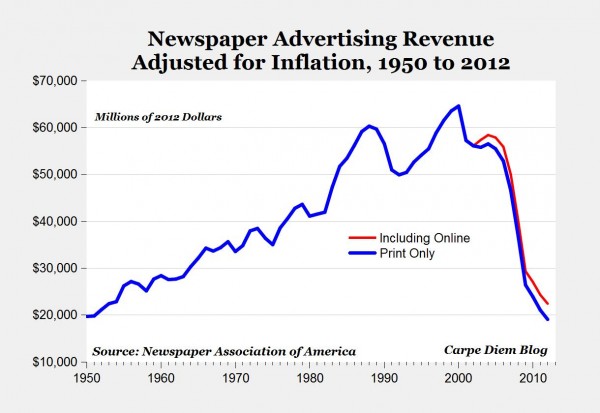
Why did the newspaper industry suddenly collapse like that? Because it got hit from two sides at once by the Internet. Craigslist and eBay took away their classified ad business, while blogs and online news sources directed their readership elsewhere for the same information. Newspapers might have been able to handle a one-front battle, but a two-front battle was catastrophic.
But there’s something else that hurt the newspaper industry: the indirect nature of their feedback loop. It’s a business model that provides a service to one group of people, while taking money from a different group of people.
The best kind of feedback for a business is revenue. If your revenue increases or decreases, you’re going to notice. But when the users of your product aren’t providing the revenue for your product, your feedback loop has a natural delay to it. The people who give you revenue might lead you to innovate (or not) in a direction your users won’t like, and you won’t notice that you’re making a mistake because it takes a while for that problem to reach your bottom line. So you react too slowly, and that slowness can be fatal.
* * *
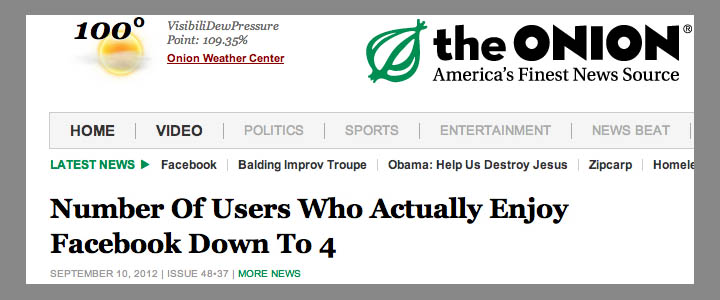
In fact, all businesses that rely on advertising have this problem. Their users want one thing, and the revenue generators want something different. So if a company like Facebook starts alienating their customers in an effort to maximize their revenues, they may find themselves not just the subject of an Onion parody, but ruining their business before the bottom line has time to let them know they’ve made a mistake.
* * *
Amazon CEO Jeff Bezos is a very smart man. He understands this problem. He knows that the key to keeping ahead of the rapid pace of high-tech change is to master the feedback loop between what his customers want next, and what his company makes next. That’s why in his Kindle press conference last week, he laid out this doctrine:
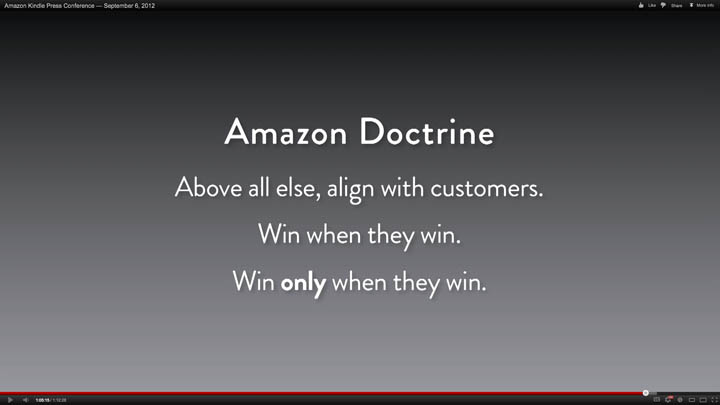
Think about the major players in high tech right now: Microsoft, Google, Facebook, Twitter, Amazon, Apple. Which of these has their revenues most directly aligned with what their customers want? It’s probably in roughly this order:
Amazon/Apple
(gap)
Microsoft
(gap)
Google
(gap)
Twitter/Facebook.
Amazon and Apple sell most of their products directly to their users. When their customers buy something they make, they know the product is good; when they don’t buy, they know immediately they made a mistake. Microsoft doesn’t sell directly to users– they sell to distributors and OEM manufacturers, so there’s noise injected into their feedback loop, and they land just a little lower on this spectrum. Google sells ads, but their ads are often directly related to what the customer wants; if someone is searching for jeans, they get an ad for jeans. Sometimes the ad happens to be exactly what the user wants.
Twitter and Facebook, on the other hand, need to inject their ads into an environment where the users wouldn’t really want to see ads at all if they didn’t have to. This leads to customer dissatisfaction, expressed not just in the Onion parody above, but also in a real-life alternative social networks like App.net who are trying to sell directly to users.
* * *
My favorite product of all is probably Major League Baseball. I consume a lot of Major League Baseball. But MLB is going in a very tempting, but dangerous direction. When MLB began, a vast majority of their revenues came from the product their users consume. They sold tickets to the games, and that’s how they made their money. But more and more of MLB’s revenues are coming from indirect sources.
At a local level, if you’re a team like the Oakland A’s, who play in an antiquated stadium that doesn’t generate a lot of revenues, a big proportion of your money comes from TV and league-wide revenue sharing. So you can do things over a number of years, like threaten to move away and trade away favorite players, that damage your brand but aren’t directly noticeable in your bottom line. Ownership may not even know how much their fans hate them, because their loyalty to their local team keeps them around despite their dissatisfaction. But eventually, there may be a straw that breaks the camel’s back. Los Angeles Dodger fans may have hated owner Frank McCourt for years, but it was only in the last year of his tenure that the dissatisfaction actually became truly noticeable in attendance figures. The feedback loop in baseball has quite a long delay.
In recent years, baseball’s misalignment problem has accelerated almost exponentially. Like the newspaper industry, the source of this change is new technology. Unlike the newspaper industry, however, the change has caused MLB’s revenues to increase, not decrease, dramatically.
The reason for this change is twofold:
So this sets up a strange mismatch between what MLB customers want, and what their revenues tell them to do. MLB fans want to watch their favorite team on whatever device they prefer. But MLB’s revenue stream is depending more and more on their customers NOT being able to watch their team over the internet, forcing them to watch on TV.
MLB’s revenues come less and less directly from baseball fans, and more and more indirectly, from TV networks and cable/satellite providers.
This causes MLB to lose control over the customer experience of their fans. If a TV network and a cable provider can’t come to an agreement on price, for example, Padres fans can go a whole season without being able to watch their team on TV. And if not all TV networks are available on all cable/satellite services, fans have to scramble around to watch the games they want.
Or, fans just go without. And what does that do? It ends up teaching them that they can learn to live without your product. That too, may not be noticeable right away, until it snowballs too late for you to do anything about it.
* * *
But you can’t really blame MLB, can you? If you’re the Los Angeles Angels and someone wants to pay you $3 billion dollars over 20 years for your TV rights, do you turn that down? No, probably not.
In expectation of an even larger payday than the Angels got, the Los Angeles Dodgers recently sold for $2.1 billion. Given that the estimated value of the Dodgers just a year before that was about $800 million, over 60% of the value of the franchise lies in that regional TV deal.
But think about that for a second. The new owners of the Dodgers spent $1.3 billion dollars on a business model that:
(a) depends almost entirely on another industry that isn’t growing, and would be in steep, steep decline without your industry. If either one of your industries catches a cold, the other one will necessarily start sneezing.
(b) puts your industry in a complete misalignment with your customers, requiring you to prevent your customers from consuming your product in the way they’d prefer, distancing yourself from the revenue feedback loop, making it more difficult to know if you’re doing any long-term damage to your product, and where you need to improve.
The new Dodger owners obviously didn’t care. Maybe they didn’t think about these risks. Or maybe they did, and thought the math worked anyway. Or maybe they considered it, but they thought they could sell the team to someone else before the whole house of cards fell in, like an investor in a Ponzi scheme who doesn’t think he’ll be the one who ends up being the victim.
Who knows. But me, I wouldn’t touch a business model like that with a 10-mile pole.
As a first step in trying to get myself to write more and shorter blog entries, I have set up a link blog, at linkblog.arneson.name.
For this, I set up a bunch of “If This Then That” tasks over on ifttt.com. Every time I mark a favorite on Twitter, YouTube, Vimeo, Delicious, Tumblr, Flickr, or Google Reader, IFTTT will take that content and create a blog entry on my linkblog.
Next, I hope to create a tool where I can click a button on the linkblog, and it will grab the linkblog entry content and include it for a new post on this blog. Then all I have to do is add some short commentary without doing any time-consuming work of cutting, pasting, saving and so forth. All I’ll have to do is my normal reading of my feeds, and click the “favorite” button whenever I see anything I might want to comment on.

In a recent episode of Louie, Louis CK tells a joke that he admits he doesn’t know how to finish. It involves a duck who thinks he’s special because he has a green head.
This blog entry — heck, this blog — is like that. I’m not sure where I’m going with it, I don’t know how it will end, I just have a feeling that I’ve got something here that can come together in the end.
* * *
I recently took one of those online narcissistic personality tests. I scored “normal”. But the only reason I even got as high as normal was because I had an over-the-top score in the “superiority” subsection. I’m not vain or power-mad at all, but dammit, facts are facts. I’m special. I have a green head.
* * *
The Louie show fascinates me. If you put me in a focus group where I was holding one of those dials while watching it, I’d probably flatline at the bottom the whole episode. I squirm, I cringe, I feel uncomfortable the whole time I’m watching it, thinking “I hate this I hate this I hate this.” Based on my real-time reactions, the network execs would probably cancel the show. But when you ask me afterwards how I feel about the episode, I usually love it.
Nobel Prize winning behaviorial economist Daniel Kahneman had demonstrated how humans have two distinct kinds of happiness. There’s a happiness that one experiences in the moment, and there’s a second kind of happiness that one feels in remembering things afterwards. The two kinds of happiness don’t necessarily correlate with each other at all.
The standard sitcom focuses like a laser on the experiential kind of happiness. We’ve all watched these shows–30 minutes of set up, punchline, laugh–but the remembrance of it usually leaves us feeling empty. I think Louie’s uniqueness stems from an indifference to the happiness of experience, if not an outright avoidance of it. The show cares more about afterwards, the happiness of memory.
* * *
Steve Jobs recently retired as CEO of Apple Computers. It’s been a helluva career. In the one and only commencement speech he ever gave, Jobs said:
Again, you can’t connect the dots looking forward; you can only connect them looking backwards. So you have to trust that the dots will somehow connect in your future. You have to trust in something — your gut, destiny, life, karma, whatever. This approach has never let me down, and it has made all the difference in my life.
From most accounts, Jobs could be a mean sonofabitch to work for. The experience at the time of creating all those great Apple products was probably miserable thanks to Jobs’ harsh taskmastery, but after seeing the results, the memory of it afterwards was probably amazing.
* * *
But there’s one nagging question I have about this philosophy: what if you only think you have a green head? What if your self-image is deceptive? What if you’re really something other than what you think you are? Why a duck? Why a no chicken?
* * *
There’s a scene in another episode of Louie where Louis CK has lunch with a Hollywood executive. She asks him for his sitcom ideas, and he starts explaining his idea for a show that avoids experiential pleasure. But he can’t explain how it’s special, how it pays off in the end. He’s envisioning a green-headed duck, trusting that the dots will connect and there will be a green-headed duck in the end, but what he’s describing sounds to the executive like a chicken with some sort of deadly disease.
It’s safer and easier, not just for network executives but for human beings in general, to follow the immediate feedback, to trust the constant data streaming in from our current state of happiness, rather than ignore that short-term data and believe that something larger and more rewarding will emerge.
Postponing pleasure now for a bigger payoff later is very risky. If you’re not special, if you can’t make the dots connect, if there’s no big payoff in the end, no pot of gold at the end of the rainbow, no heaven waiting for you after a virtuous life, if you don’t really have a green head, then you’ve got nothing to show for it but misery. No happiness from experience, and no happiness from memory, either.
That’s why shows like Louie don’t get made very often. That’s why companies like Apple are unique rather than ubiquitous. Because most of the time, none of it was worth it. You were just being an asshole for no good reason.
* * *
I’ve worked in the high tech industry from the infancy of the world wide web, and I’ve seen a lot of companies (including some of mine) start out with the Applest of intentions. But then the feedback starts coming in, from customer service and sales, and it’s nearly impossible for anyone who isn’t a complete narcissist to say “nope, our customers are wrong and our vision is right.” Because usually the customers are right and your vision is wrong. So you follow the feedback. Be the bird that you are, and you usually have a pretty decent gig.
* * *
Modern electronic writing is primarily a pleasure-of-the-moment activity. Today’s blog entry is forgotten tomorrow. Our tweets are out of mind as soon as they scroll off our feed. We’re reacting in the moment to last night’s game, this morning’s article, tonight’s political speech. Which is fine, that’s what these media are meant to do. They’re chickens. Chickens are great, as long as you’re not expecting a duck.
* * *
Lately, I’ve had offers to write for a number baseball outlets out there. I’ve thought about trying a Craig Calcaterra, to see what I could accomplish I left my old, higher-paying career to commit to writing full time.
But so far, I’ve (mostly) resisted that temptation. My gut tells me, “don’t make that commitment.”
It’s partly because I don’t have all my ducks in a row in my personal life to make that practical right now. I quit writing regularly two years ago because I was juggling too many balls in my life, and I ended up doing a half-assed job on all of them. I hate feeling like I’m not living up to expectations, I hate feeling like I need to work 24/7 in order to avoid feeling like I’m not living up to expectations, so I resist making commitments that would create any expectations. Hence, for now, this blog, where I can do what I like, when I like, how I like with maximum flexibility and minimum commitment.
It’s probably also because I’m narcissistic enough to believe I’m unique. I’m not ready to cooped up and commit to a life as a chicken. I’m not ready to accept that this is how I finish this story. I feel, rightly or wrongly, that I’m my own species, who simply has not yet encountered the right variety of poultry to fall in love with.